There are few things more tedious than being ill, particularly when one has reached an age at which the body has already accumulated a respectable collection of complaints. At fourteen, I am familiar with stiff joints, questionable eyesight, and the occasional morning when getting out of bed requires more negotiation than it once did. I have learned to accept these things with dignity. This week, however, dignity became difficult.
My stomach betrayed me thoroughly. There was vomiting. There was diarrhea. There were hurried trips outside at times when civilized dogs should be asleep. I spent most of the week lying down, which under ordinary circumstances would have suited me perfectly. I am, after all, an experienced practitioner of rest. But there is a considerable difference between lying down because one wishes to and lying down because standing up suddenly seems like an ambitious undertaking. This week, unfortunately, I was doing the latter.
The surprising part was that Agatha noticed. Normally, a stationary Charlie presents her with an opportunity. If I am in bed, she investigates me. If I stand up, she appears. If I begin walking somewhere, some deeply rooted instinct in her small and disorderly mind informs her that my direction of travel requires supervision. She circles, bumps, blocks, and attempts to guide me as though I am an elderly sheep who has wandered away from the flock. I have explained repeatedly that I am not livestock, but this has not discouraged her in the slightest.
While I was sick, though, she behaved differently. She still checked on me, of course, because she is physically incapable of ignoring anything that happens within the boundaries of the house, but there was less bouncing, less interference, and considerably less enthusiasm for reorganizing my movements. Several times I woke to find her nearby, watching me without actually climbing on me, nudging me, or attempting to involve me in one of her projects. I noticed this change and chose not to comment on it. A puppy should not become overconfident simply because she has managed to display basic decency.
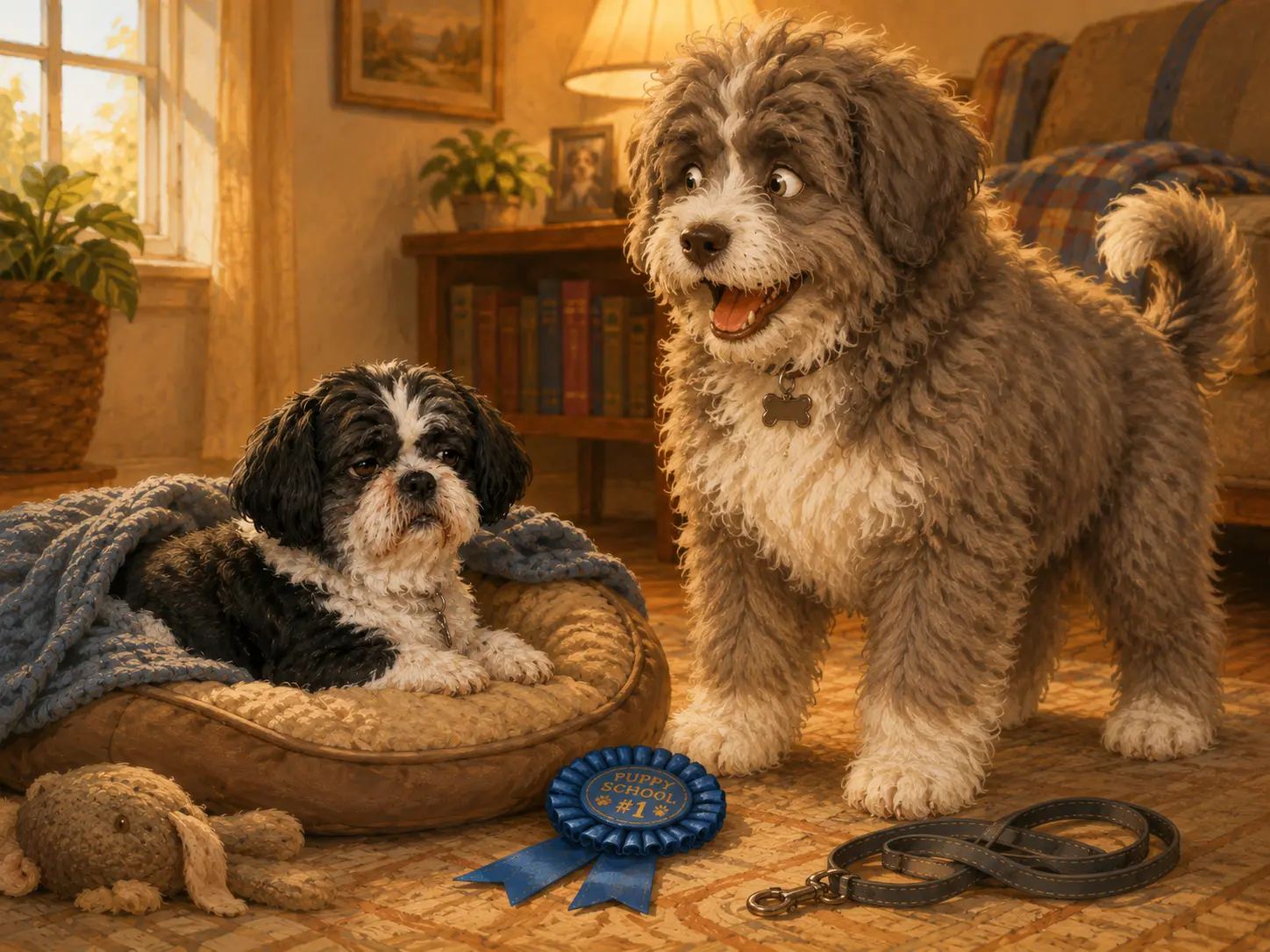
Later in the week, Agatha returned from puppy school overflowing with the sort of pride normally reserved for military victories and major scientific discoveries. I was resting when she informed me that she had been the smartest dog in her puppy school class. I opened one eye, considered this claim carefully, and pointed out what seemed to me a rather important detail.
“You are the only dog in your class.”
Agatha stared at me for a moment, apparently processing my objection, and then her tail began wagging again. “But I was still the smartest.”
Unfortunately, she had a point.
My people were very pleased with her progress. Agatha had learned new commands, improved on old ones, and apparently impressed her instructor. She could sit when asked, wait when asked, walk properly beside a person, and perform several other behaviors dogs have managed for centuries without certificates, public celebration, or a steady supply of tiny treats. Agatha, naturally, considered all of this extraordinary. I remained appropriately reserved because someone in this family must preserve standards.
Still, while she continued celebrating her academic achievement, I found myself thinking about the creature who had arrived here only a few weeks earlier. That Agatha had been almost entirely made of motion. She bounced into rooms, through rules, and occasionally into me. She understood very little and obeyed even less. The concept of personal space seemed to offend her philosophically, and every correction merely introduced another fascinating question about what she might get away with next.
She is still Agatha, of course, and no one should misunderstand me. She still has entirely too much enthusiasm. She still believes every event in the household might somehow involve her. She still possesses the baffling conviction that my movements require her assistance. But she is not quite the same Agatha who first arrived.
She listens more often now. She waits occasionally. She knows words that once meant nothing to her, and she has begun watching the people closely enough to understand what they expect. More importantly, this week she recognized something no one had taught her in puppy school. She understood that I did not feel well, and for the most part, she left me alone. That required no command, no treat, and no instructor standing nearby with a pouch full of rewards. She simply noticed.
I would never tell her how much that impressed me. There are boundaries, after all, and encouraging Agatha unnecessarily seems reckless. Yet as much as it pains me to admit it, the Small Menace is improving. Somewhere beneath the bouncing, sniffing, and inexplicable enthusiasm, something resembling judgment may actually be developing. She is beginning to understand that living in a household requires more than knowing where the food is kept and how quickly one can reach the door.
So yes, I quietly applauded her success. Very quietly, and entirely internally, because there is no reason to make a spectacle of these things. If she continues at this rate, there may eventually come a day when I am forced to acknowledge that Agatha has become a reasonably competent member of this household.
Before we begin discussing honors, diplomas, or advanced placement in puppy education, however, there remains one significant area of study. She must stop trying to herd me. I am not a sheep. I have never been a sheep. And if the smartest dog in her class cannot learn that, then I have serious concerns about the curriculum.