
There are certain words capable of restoring youth to even the most distinguished elderly gentleman.
“Dinner” is one.
“Treat” is another.
But the most powerful words in the English language are these:
“Charlie, wanna go for a ride?”
I may be fourteen years old. My eyesight may be largely decorative, and my knees may require several minutes of negotiation before beginning any serious activity. None of that matters when a ride has been proposed.
I stood at once.
Then, in a brief and entirely justified departure from my usual dignity, I performed the dance.
It is a small dance, conducted mainly with the front legs. The paws rise. The paws fall. The body bounces just enough to communicate enthusiasm without suggesting a complete loss of self-control.
My people understand what it means.
The truck was being prepared. The Ride was imminent.
Before we could leave, however, there were plants to be watered. My people had arranged a number of small pots outside, each containing young plants that required careful attention. The pots stood in neat rows with perfectly adequate walking space around them.
Agatha walked directly across the pots.
She placed one foot between two plants, stepped over another, nearly sat on a third, and emerged on the opposite side wearing the satisfied expression of an explorer who had successfully crossed a dangerous mountain range.
There had been no mountain range.
There had been a path.
“Stay out of the plants,” one of my people told her.
Agatha looked back at the pots as though surprised to learn they had been involved.
This was not the first rule she had discovered by breaking it. I suspected it would not be the last.
I remained at a safe distance and continued supervising.
The hose was brought out.
I have never understood the human desire to take water, which belongs properly in bowls, ponds, and controlled indoor plumbing, and fire it through the air. Rain is bad enough. Rain, at least, can be blamed on the weather. A hose represents a deliberate decision.
The water began flowing into the pots.
Agatha froze.
She stared at the stream with the intense concentration of a creature encountering something beyond her understanding.
Then she attacked it.
She lunged forward with her mouth open and attempted to bite the water. The water struck her in the face. She jumped backward, shook herself, and stared at it.
A reasonable dog would have accepted the result.
Agatha charged again.
She snapped at the stream. She pawed at it. She tried to catch it as it moved from one pot to another. Each time she believed she had trapped it, the water escaped through her teeth and continued about its business.
She became soaked.
This did not discourage her.
The water was apparently an enemy, a toy, or possibly both. Agatha had not yet developed the ability to distinguish between those categories.
I moved farther away.
Not because I was afraid of the hose. I simply saw no advantage in standing where poorly directed weather might occur.
Once the plants had been watered, another machine appeared.
The blower.
I dislike the blower.
It is loud. It produces wind without permission. It sends leaves, dirt, and small objects skittering across the ground when they had previously been resting in perfectly acceptable locations. Nothing about it improves the peace of an afternoon.
When the machine started, I retired to a sheltered position.
Agatha did the opposite.
The air struck her in the face, flattening her fur and pushing her ears backward.
She barked at it.
The air continued blowing.
She lowered her front legs, raised her rear end, and challenged the invisible force to come closer.
The invisible force did.
It pushed against her cheeks. It lifted the fur around her head. It made her blink rapidly and shake her ears.
Agatha snapped at it.
For several minutes, I watched a puppy lose an argument with the atmosphere.
The atmosphere remained calm throughout.
Eventually, the blower was turned off. Agatha stood in the sudden silence, looking around for the opponent that had vanished without explanation.
She had discovered invisible things.
She had not yet discovered that some invisible things should be left alone.
At last, the outdoor work was finished.
My people returned to the matter of the ride.
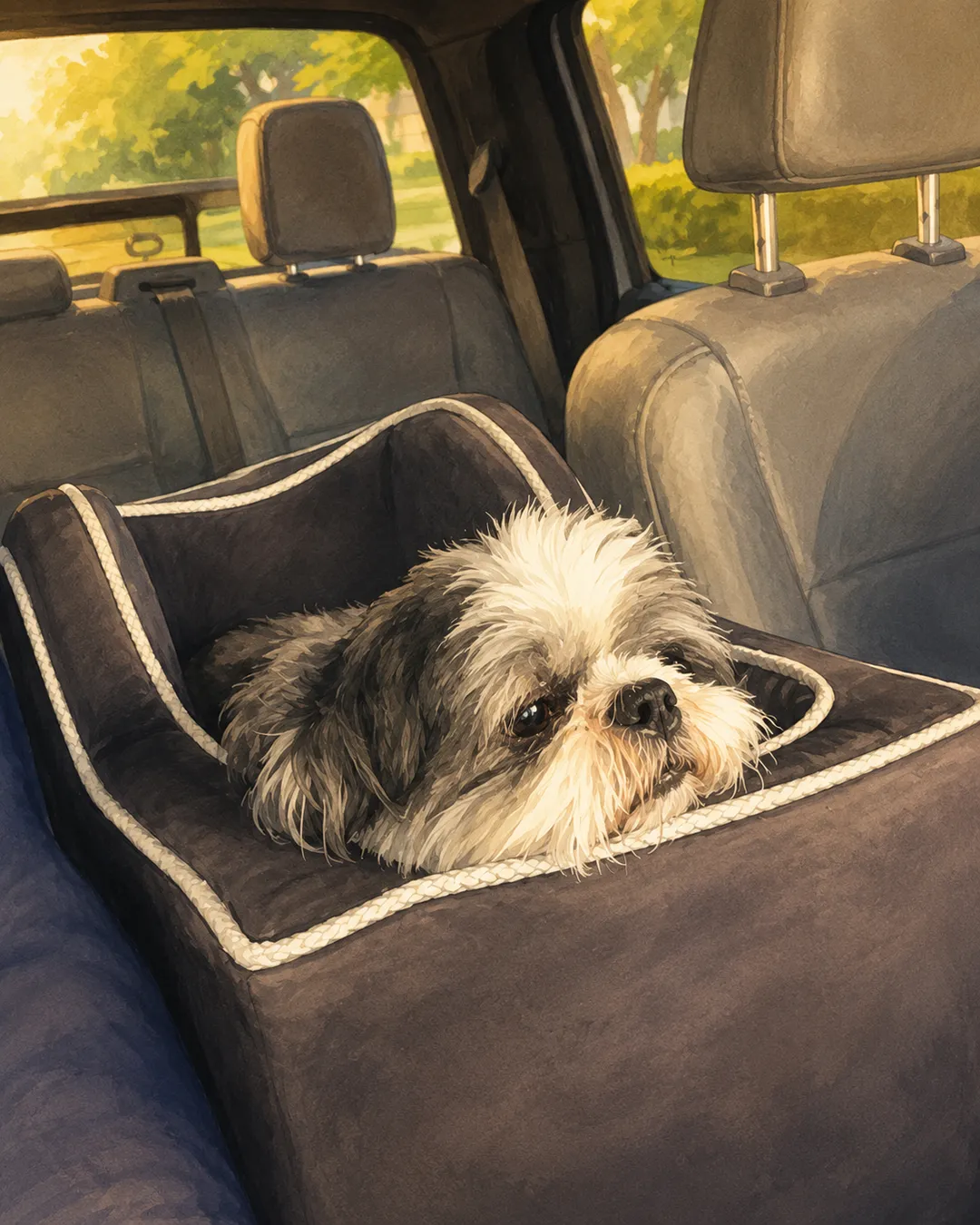
I was placed in my black-and-white car seat in the front of the truck, between the driver and passenger seats. It is plush, properly positioned, and directly in front of the air conditioner.
This is how a civilized dog travels.
The seat allows me to remain close to both of my people while enjoying cool, filtered air delivered at a reasonable speed. I may sit upright to supervise the journey or lie down and sleep while the truck carries me comfortably from one location to another.
Agatha has her own car seat.
Hers is larger and pink. It sits in the back seat and includes proper safety straps designed to keep a dog securely contained while the vehicle is moving.
I approved of this arrangement.
The pink seemed appropriate.
The restraints seemed necessary.
Agatha was placed in her seat and fastened safely into her harness. For a brief moment, she sat properly.
Then the window went down.
Wind rushed into the truck.
I do not care for open windows. A truck already contains an excellent air-conditioning system. There is no sensible reason to replace cool, controlled air with hot wind carrying dust, pollen, insects, road grit, and the accumulated smells of the surrounding countryside.
Agatha disagreed.
She climbed to the edge of her pink seat and leaned toward the open window.
Then she leaned farther.
Her front paws braced against the door. Her head stretched outside. Her ears flew backward. Her fur rippled. Her tongue escaped from the side of her mouth and began flapping in the wind.
The safety harness held her securely.
I knew it would hold.
My people had fastened it correctly. The straps were strong. The seat was stable.
I checked anyway.
Agatha leaned farther into the rushing air, apparently delighted to discover that the invisible thing from the blower lived beside the road as well.
I considered every possible outcome.
A large insect could strike her in the nose. Dust could enter her eyes. Her harness could become twisted. She could lose her balance when the truck turned. She could distract the driver. Something might fly from the roadside and hit her. Her tongue might become permanently displaced.
There was also the matter of decorum.
People in passing vehicles could see her.
Our family had a reputation to maintain.
I sat upright in my black-and-white seat, calm and properly contained, while Agatha flapped from the back window like laundry that had not been adequately secured to a clothesline.
I was not worried about her.
I was concerned about safety standards, proper restraint, and the public reputation of everyone traveling in the vehicle.
The truck turned.
Agatha shifted in her seat.
I checked the harness.
It held.
She leaned into the wind again.
I checked the harness a second time.
Still secure.
Her ears slapped against the sides of her head. Her nose worked rapidly as hundreds of smells rushed past her. Every field, driveway, mailbox, animal, puddle, and patch of grass seemed to deliver a new message.
She was trying to smell all of them at once.
Her entire body trembled with excitement.
For one brief moment, I remembered when riding in the truck had been new to me. I remembered when the road seemed to contain endless possibilities and every turn led somewhere unknown.
Agatha looked ridiculous.
But she also looked happy.
Then a large truck passed us in the opposite direction.
The sudden rush of air struck the side of our truck with a roar.
Agatha jerked backward into her seat and gave a frightened little whimper.
I was on my feet immediately.
I twisted around in my car seat, straining to see into the back. Had she slipped? Had the harness tightened around her? Had something struck her? Was she hurt? Why had no one stopped the truck?
“Agatha?” I called.
She looked toward me.
Both eyes were open. Her ears remained attached. The harness still held her safely in the center of the pink seat.
My people spoke to her in calm voices. One of them reached back to reassure her. Within moments, her tail began moving again.
I settled into my seat.
There had been no reason for alarm.
I had not been alarmed.
I had merely conducted an immediate safety inspection in response to an unusual sound from the rear passenger area.
Agatha cautiously approached the window again, although this time she did not lean quite so far into the wind.
I approved of this adjustment.
Not that I had been worried about her.
After several minutes, Agatha pulled her head back inside the truck.
I examined her carefully from the front seat.
Both eyes remained in place. Her nose appeared undamaged. Her tongue had returned to approximately its proper position. No insects were visibly lodged in her mouth.
Her ears were crooked.
“Your ears are crooked,” I informed her.
Agatha panted happily and looked toward the open window.
“Air!” she announced.
I knew it was air.
I had known about air for many years.
Air is useful for breathing. When cooled and directed through a dashboard vent, it is also useful for sleeping. When blasted from a machine, pushed through an open truck window, or combined with water from a sprinkler, it becomes unnecessary.
Agatha, however, believed she had discovered something magnificent.
My people raised the windows.
The rushing wind disappeared, leaving only the quiet hum of the truck and the soft, controlled air from the vents. I settled into my black-and-white seat, lowered my head, and returned to the proper business of enjoying the ride.
Agatha remained upright in the back.
She stared at the closed window.
A moment earlier, the air had rushed against her face, pulled at her ears, and carried the entire countryside directly to her nose. Now it had vanished behind a sheet of glass.
Or so I assumed she believed.
She tilted her head and listened.
The wind still whispered around the truck. It slipped along the doors, murmured past the window, and rose and fell with the speed of the road. Agatha’s ears moved slightly as she followed the sound.
She had found it again.
Her invisible discovery was still outside, running alongside the truck where she could hear it but no longer reach it.
I watched her for a moment.
Then I rested my head and closed my eyes.
She had a proper car seat. She had secure safety straps. The windows were closed. The dangerous portion of the afternoon had ended.
There was no longer any reason for me to remain awake.
Not that I had been worried.
Agatha had discovered the air.
I had enjoyed a ride.
Of the two accomplishments, mine was unquestionably the more dignified.