

There are certain patterns one learns after living with people for fourteen years.
People imagine that dogs do not understand their routines. This is because people frequently confuse an inability to operate a washing machine with a lack of intelligence. I understand my people perfectly well. In many cases, I understand what they are doing before they do.
For example, when overnight bags appear on the bed, dirty laundry is gathered into baskets, dog food is measured into containers, and everything begins accumulating beside the front door, it means we are going somewhere.
More importantly, it means we are going for a ride in the truck.
I adore riding in the truck.
The instant I realized what was happening, I abandoned my bed and hurried toward the growing collection of bags. My knees objected, of course, but excitement is one of the few circumstances under which their complaints may be temporarily overruled. I performed my customary departure dance, lifting one front foot and then the other while turning in a single, but efficient little circle.
“We are going for a ride,” I announced.
Agatha looked up from the dish towel she had been attempting to remove from the kitchen. Her ears rose immediately.
“A ride? Where are we going?”
“That remains to be determined.”
There were two usual possibilities. We might be visiting our younger daughter, where Cu Sidhe lived. Cu Sidhe was a Newfoundland of extraordinary dimensions, accompanied by two cats named Milo and Fiadh and a six-year-old granddaughter who possessed nearly as much energy as Agatha.
Alternatively, we might be going to our older daughter’s house, where Misty lived. Misty was a black Labrador with a large fenced yard and no children.
Either destination required preparation.
I watched Agatha bounce toward the bags and immediately recognized that she had no understanding of the responsibility before us. She attempted to leap over the laundry basket, and I stopped her before she could scatter undergarments across the floor.
“We are not merely going for a ride,” I told her. “We are going to be guests in someone else’s home, which means we are representing the family.”
Her tail slowed.
“Representing them how?”
“Through our behavior. A guest must be courteous, restrained, and respectful of the household.”
“I know rules,” she said.
“You know that rules exist. That is not the same thing.”
She sat down and looked at me expectantly. This was promising, although I suspected the sitting had happened accidentally.
I explained that she must not charge through the door before being invited, inspect anyone else’s food bowl, climb on furniture without permission, bark unnecessarily, chew household possessions, chase cats, dig holes, steal toys, overturn water dishes, or create disturbances during the night.
Agatha’s eyes widened with each addition.
“That is a lot of rules.”
“It is a partial list.”
“There are more?”
“Many more.”
She glanced toward the bags as though the journey had suddenly become less appealing.
“What if I forget one?”
“You must not.”
“But what if I do?”
“Our family honor is at stake.”
I am not certain Agatha understood the concept of honor, but she understood from my tone that it was important. From that moment forward, she became unusually quiet.
When the truck was finally loaded, I took my proper place in my black-and-white car seat between the driver and passenger seats, directly in front of the air conditioner. Agatha was secured in her larger pink seat in the back.
Ordinarily, she spent much of a ride attempting to investigate every visible object at once. This time, she did not lean toward the window, bounce in her seat, or strain against her harness. She sat stiffly and watched me.
“Remember,” I told her, “we enter calmly, greet our host politely, and do not embarrass the family.”
She nodded at each instruction, but her ears lowered a little farther every time I spoke.
By the time we arrived, I had determined that our destination was Misty’s house. The large fenced yard was visible beyond the driveway, and Misty herself was waiting inside.
Misty is a substantial dog. She is considerably larger than I am, although most creatures are. Even Agatha, who had grown to an unreasonable size since joining our household, appeared small beside her.
The door opened, and Agatha stepped inside cautiously.
“Calmly,” I reminded her.
“I am being calm.”
“Do not rush Misty.”
“I’m not rushing.”
“And do not sniff anything inappropriate.”
Agatha looked alarmed. “I don’t know what is inappropriate.”
“You should.”
Misty approached to greet us, and Agatha froze.
“Be polite,” I whispered.
“I’m trying.”
“Do not stare.”
“I’m not.”
“You are staring now.”
Agatha looked away so quickly that she nearly lost her balance.
The people began carrying in bags and laundry while Misty followed them through the house. I proceeded inside with the dignity expected of a senior representative of the family. Agatha remained near the entrance, looking from Misty to me and back again.
“Remember that this is Misty’s home,” I told her. “Her possessions take priority. Her routines take priority. Her comfort takes priority.”
Agatha swallowed.
Then she peed on the floor.
It was not an impressive quantity, but quantity was not the issue.
The people reacted immediately. Towels appeared, voices rose, Agatha crouched lower, and Misty stepped aside. I closed my eyes.
The visit had barely begun, and already the family honor had been dampened.
“It was an accident,” Agatha whispered.
“I am aware.”
“I got nervous.”
“You must remain composed.”
“I’m trying.”
Unfortunately, the more everyone attempted to calm her, the more nervous she became. The more nervous she became, the more likely she was to tinkle. Each small incident caused the people to become more watchful, which caused Agatha to become more anxious, which caused further incidents.
It was an exhausting cycle.
I attempted to assist by reminding her of the rules, although my guidance did not produce the results I had expected.
“Do not get too excited,” I told her.
“I’m not excited.”
“Then do not look nervous.”
“I am nervous.”
“Then stop.”
She stared at me as though I had offered no useful advice whatsoever.
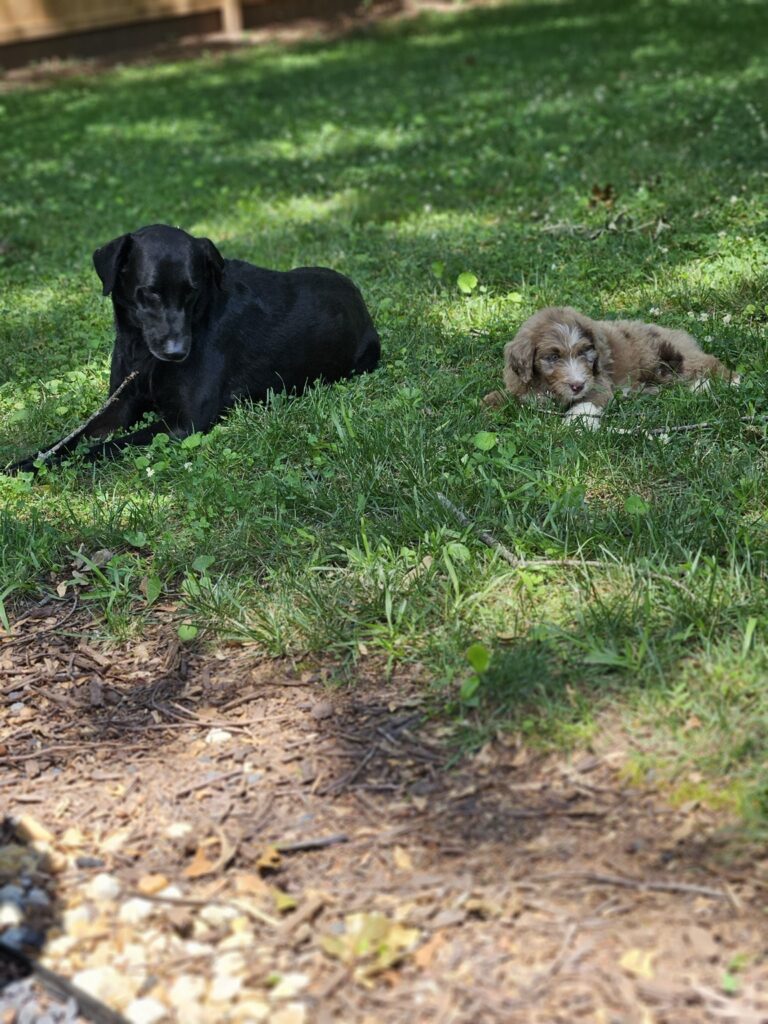
Fortunately, the visit was not an unmitigated disaster. Misty and Agatha spent considerable time together in the yard. Misty was large enough to withstand Agatha’s enthusiasm and patient enough to tolerate it for several minutes at a time.
They chased each other across the grass, wrestled, and ran in wide circles until Agatha’s tongue hung from her mouth and her legs could no longer agree on a direction. For a while, she forgot to be nervous.
The difficulty came when Misty had finished playing and Agatha had not.
Misty would turn away, and Agatha would follow. Misty would lie down, and Agatha would bounce beside her. Misty would issue a low growl, and Agatha would pause long enough to consider this information before attempting to resume the game.
At that point, Misty would bark sharply, and Agatha would leap backward in surprise.
“Excellent correction,” I told Misty. “Clear, firm, and entirely justified. I have been attempting to teach her restraint for some time.”
Misty glanced at me before looking back toward Agatha, who was examining a patch of grass as though she had never intended to play at all.
“Your method appears effective,” I continued.
Misty walked away.
She was a dog of few words, but I sensed professional respect between us.
The visit lasted two nights. Agatha never fully relaxed, although she made a sincere effort. She played, explored the yard, followed the people from room to room, and attempted to behave properly.
She also continued to tinkle occasionally whenever she became frightened, excited, corrected, greeted, surprised, or reminded not to tinkle.
By the second evening, the people were tired, Agatha was tired, and even Misty appeared ready for the household to return to normal. I remained composed throughout, although maintaining family dignity under such circumstances requires considerable effort.
On the final morning, the overnight bags reappeared. The laundry was gathered, the dog food was packed, and everything was carried back toward the door.
Agatha watched carefully.
“We are going for a ride,” she said.
“Yes.”
“Home?”
“Yes.”
Her entire body relaxed.
Once we were secured in the truck, she curled into her pink seat and released a long breath.
“I like home rules better,” she said.
“You do not follow those either.”
“But I know where they are.”
I considered this and decided it was not an entirely unreasonable point.
When we finally returned home, Agatha hurried inside and inspected every room as though confirming that nothing had changed during our absence. Then she collapsed onto the floor in the middle of the household she routinely disrupted.
I returned to my bed.
Family honor had survived, although not without stains.
Agatha had learned that visiting another home involved unfamiliar dogs, unfamiliar expectations, and a troubling number of additional rules. I had learned that repeatedly telling a nervous creature not to be nervous does not appear to improve matters.
I do not intend to make a habit of admitting that.
Some lessons are best kept private.